
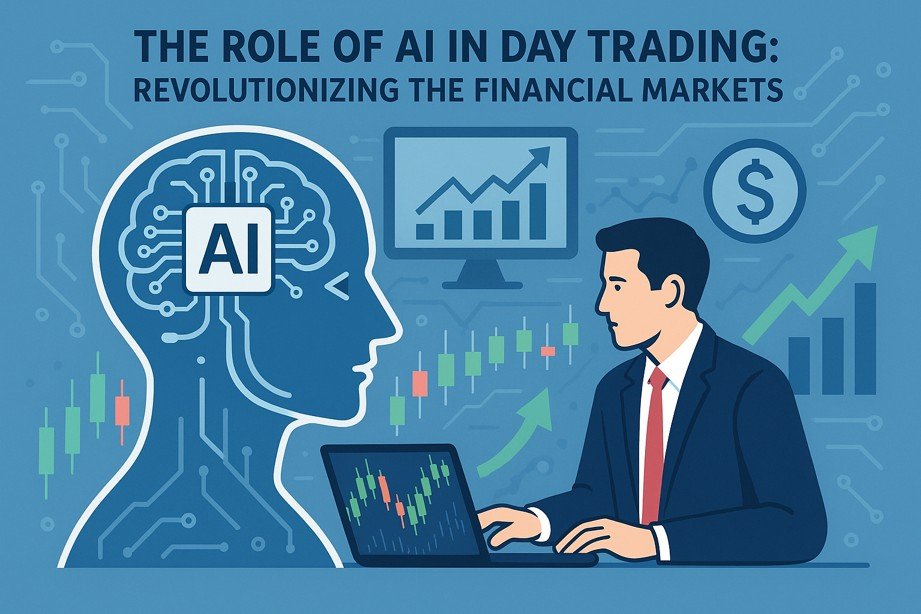
Artificial Intelligence (AI) is transforming industries worldwide, and the financial markets are no exception. Day trading, known for its fast-paced and data-intensive nature, has become an ideal domain for AI technologies to thrive. From analyzing market trends in real-time to executing trades with precision, AI is reshaping how traders approach the markets, offering unprecedented opportunities for efficiency, accuracy, and profitability.
This blog explores how AI is revolutionizing day trading, its benefits, challenges, and what the future holds for this exciting intersection of technology and finance.
How AI is Used in Day Trading
AI enhances day trading by automating processes, uncovering insights from vast amounts of data, and making decisions faster than any human trader could. Here are some ways AI is applied in day trading:
1. Algorithmic Trading
AI powers algorithmic trading, where predefined rules and strategies are used to execute trades automatically. These algorithms can:
Identify patterns in price movements.
Execute trades at optimal times, often within milliseconds.
React to market changes faster than human traders.
This speed and efficiency make AI-driven algorithms a key tool for day traders seeking to capitalize on short-term price fluctuations.
2. Predictive Analytics
AI leverages machine learning models to predict market movements based on historical data and current trends. By analyzing patterns and indicators, AI can provide:
Accurate forecasts of asset price movements.
Recommendations on when to buy or sell.
Insights into market sentiment using social media and news data.
Predictive analytics helps traders make informed decisions, reducing the guesswork often involved in day trading.
3. Sentiment Analysis
AI tools can analyze the sentiment of news articles, social media posts, and other public data sources to gauge market sentiment. For example:
An AI system can quickly identify if news about a company is positive or negative.
It can analyze the tone of social media conversations about a stock or cryptocurrency.
This real-time information gives traders valuable insights into market sentiment, helping them anticipate price movements.
4. Risk Management
AI-powered risk management tools monitor trading activities and portfolios to minimize potential losses. These systems can:
Assess the risk-reward ratio of trades in real time.
Recommend position sizes and stop-loss levels.
Alert traders to potential overexposure or market volatility.
By improving risk management, AI helps traders protect their capital while maximizing returns.
5. High-Frequency Trading (HFT)
AI drives high-frequency trading strategies, where trades are executed at incredibly high speeds. AI systems analyze market conditions and execute large volumes of trades across different markets, exploiting tiny price discrepancies. The advantages include:
Faster trade execution than human capability.
The ability to process data and make decisions in microseconds.
Scalability to handle thousands of trades simultaneously.
HFT is one of the most profitable applications of AI in day trading.
6. Portfolio Optimization
AI doesn’t just focus on individual trades; it can also optimize entire portfolios. By analyzing correlations, diversification, and risk, AI ensures that a trader’s portfolio is structured to maximize returns while managing exposure to risk.
The Benefits of AI in Day Trading
AI offers several advantages that are transforming the day trading landscape:
1. Speed and Efficiency
AI can analyze massive amounts of data and execute trades within milliseconds, far faster than any human trader. This speed is crucial in the world of day trading, where opportunities can disappear in seconds.
2. Accuracy and Consistency
AI-driven systems remove human emotion from trading decisions, ensuring that trades are executed based on data and logic rather than fear or greed. This leads to more consistent performance over time.
3. Data-Driven Insights
AI processes vast amounts of structured and unstructured data, identifying patterns and trends that would be impossible for a human to detect. This gives traders a competitive edge by uncovering opportunities hidden in the data.
4. 24/7 Trading
AI systems can operate around the clock, enabling traders to participate in global markets even when they’re asleep. This is especially useful in cryptocurrency markets, which never close.
5. Risk Reduction
By automating risk management processes, AI reduces the likelihood of costly mistakes. It ensures that trades are executed within pre-defined risk parameters, protecting traders from large losses.
Challenges of Using AI in Day Trading
While AI has many benefits, it’s not without its challenges:
1. High Initial Costs
Building or purchasing an AI trading system requires significant upfront investment in technology, infrastructure, and talent.
2. Complexity
AI systems can be complex to set up and maintain. Traders need a strong understanding of both financial markets and AI technology to use these systems effectively.
3. Dependence on Data
AI systems are only as good as the data they’re trained on. Poor-quality or incomplete data can lead to inaccurate predictions and flawed trading decisions.
4. Regulatory Concerns
As AI takes on a larger role in day trading, regulators are paying closer attention. Ensuring compliance with local laws and regulations can be a challenge for traders using AI.
5. Market Volatility
While AI excels in stable conditions, extreme market volatility (e.g., during economic crises or geopolitical events) can cause algorithms to make unexpected or suboptimal decisions.
The Future of AI in Day Trading
The role of AI in day trading is set to grow as technology continues to evolve. Here are some trends shaping the future:
1. Increased Use of Deep Learning
Deep learning models will allow AI systems to better understand complex market behaviors and predict trends with greater accuracy.
2. Democratization of AI Tools
As AI becomes more accessible, even small-scale traders will have access to advanced tools that were once limited to institutional investors.
3. Integration with Blockchain and Cryptocurrencies
AI will play a key role in analyzing and trading cryptocurrencies, leveraging blockchain data to identify trends and opportunities in an increasingly digital economy.
4. Enhanced Collaboration Between Humans and AI
The future of trading will likely involve a symbiotic relationship between human traders and AI systems, where humans provide strategic oversight and creativity while AI handles data analysis and execution.
AI is revolutionizing day trading, offering traders unparalleled speed, accuracy, and insights. By automating processes and analyzing data at scale, AI enables traders to capitalize on opportunities faster and more effectively than ever before. However, it’s essential to approach AI with a clear understanding of its challenges and limitations.
As AI technology continues to advance, it’s reshaping the financial landscape and opening new possibilities for traders around the globe. Whether you’re a seasoned trader or just starting, integrating AI into your trading strategy could be the key to staying ahead in today’s fast-changing markets.


